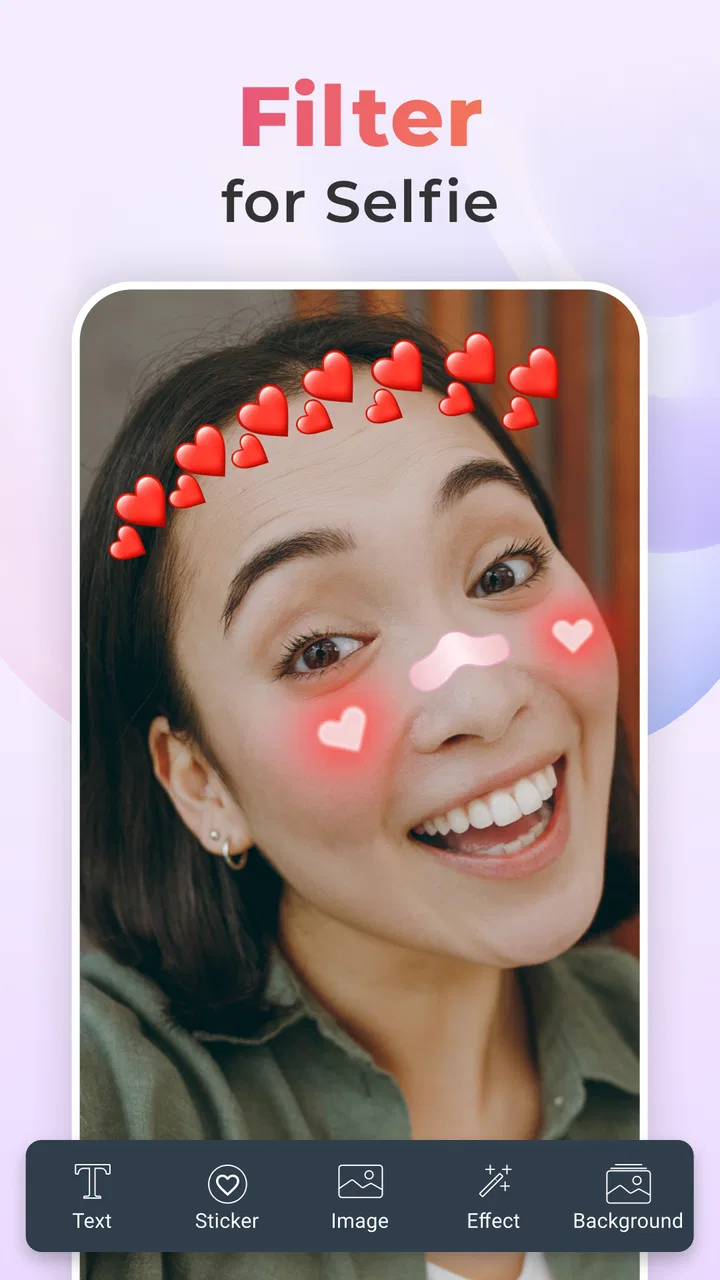
Filter for Selfie
- 4.6
- Rating
- 1.00M
- Installs
- Free
- Price

 Analysis by App-foxy
I installed Filter for Selfie expecting a quick way to make casual photos more playful, and that is exactly where it makes the most sense. This free beauty app from GeniusTools Labs focuses on selfie filters and funny face effects rather than serious retouching. I would describe it as a light, immediate tool for changing the mood of a picture before sharing it with friends, posting it socially, or simply keeping a more amusing version of an ordinary moment.
The starting point is simple: you have a front-camera photo in mind, but the unedited result feels flat or too ordinary. Instead of opening a full photo editor and working through several menus, you can use a filter-first approach. That difference matters. This is best treated as a fast expression and entertainment app, not a complete portrait-editing studio. Its appeal comes from reducing the distance between “I want a funny selfie” and “I have one ready to show someone.”
The app has built a sizeable audience, with over one million installs and a 4.7 average from around 9,600 ratings. Those figures suggest that its straightforward purpose connects with many casual users. I also found the Everyone age rating consistent with the general tone: the experience is aimed at ordinary, playful photo use rather than mature content or specialist beauty work.
You May Also Like

 Blood Strike: 2.5 Anniversary
Blood Strike’s Loadouts Turn Every Drop Into a Tactical Gamble
A close look at Blood Strike’s custom loadouts: how fast access to signature weapons reshapes its battle royale rhythm, rewards preparation, and narrows the gap between fights.

 Pandora - Music & Podcasts
Pandora’s Music Is Easy to Start, but Harder to Recover
Pandora’s strength is its low-effort path from a seed to a station. Its weak spot is how much confidence it asks you to place in connection, setup, and quiet recovery.

 8 Ball Pool
 Is Built on Rivalries, Rematches, and Routine
A close look at the rivalries, rematches, shared routines, and unanswered safety questions that turn a quick pool match into a persistent mobile community.

 Samsung Music
’s Quiet Strength Is Playing What You Already Own
Its reach comes less from spectacle than from dependable access to a personal library. That simplicity is both the app’s strongest retention engine and its ceiling.

 AccuWeather: Weather Radar
AccuWeather Review: A Quick, Clear Forecast for Everyday Decisions
For everyday plans, the best forecast is the one you can understand quickly. AccuWeather makes rain timing, radar, and local conditions easy to act on, with a few trade-offs.

 Hill Climb Racing
Why Hill Climb Racing Still Turns Crashes Into One More Run
A tiny car, a bumpy hill and one more upgrade: Hill Climb Racing keeps resurfacing because its simple chaos makes every near-miss feel personal.
More From Our News Desk
View All News


From an ordinary selfie to a shareable result
I find the most useful way to approach a selfie filter is to decide what the picture needs to do before I start changing it: make a friend laugh, add a little personality, or simply give an ordinary moment a different mood. That small choice helps me judge effects by whether they suit the occasion, not just by how striking they look on screen. Once that intention is clear, the next question is how smoothly the app supports a quick experiment.
Beginning with the right kind of photo
The best workflow starts before choosing an effect. I get better results when the face is reasonably well lit, centered, and not partly hidden by a hat, hand, or heavy shadow. Funny filters can exaggerate facial features, so a clear starting image gives the effect more room to work. If the original selfie is already crowded or poorly framed, the filter may become a distraction instead of the main point.
That makes the app particularly useful in everyday situations where speed matters. Imagine taking a quick selfie during a group chat, at home before sending a message, or while trying to make a friend laugh after a dull day. You do not necessarily want careful skin correction or a polished social-media composition. You want a visible change that communicates a mood immediately. In that situation, the playful focus is more useful than a large collection of conventional editing controls.
I would not begin here if my goal were a professional-looking profile image. For that, a standard camera app followed by a dedicated editor usually gives better control over exposure, cropping, color, and subtle retouching. Filter for Selfie is more convincing when the effect itself is part of the message.
Choosing an effect without losing the subject
Once the selfie is ready, the important decision is not simply which filter looks most dramatic. It is whether the face remains recognizable and whether the effect fits the person receiving the image. A strong distortion can be funny in a private conversation but awkward in a work-related post. I prefer testing several styles briefly, then returning to the one that changes the expression without making the original face impossible to read.
This is one of the app’s less obvious strengths: the filter can act as a communication shortcut. A normal portrait asks the viewer to interpret your mood; a humorous face effect announces that the image is meant to be playful. That can make a short message feel warmer without adding a long explanation. It is especially handy when the photo is being sent as a reaction rather than preserved as a serious memory.
There is also a useful trade-off here. The more obvious the effect, the less flexible the final image becomes. A subtle style can be reused for a profile picture or casual post, while a highly comic transformation may work only in a one-to-one joke. I recommend deciding where the photo will go before committing to the most exaggerated option.
Moving from preview to a finished image
The central flow is easy to understand: start with a selfie, try a face filter, judge the preview, and keep the version that matches the intended mood. That simplicity is valuable for people who dislike editing timelines and layered controls. I can hand the phone to someone who rarely edits photos and explain the idea quickly: find a face effect, see how it changes the image, and use the result if it feels right.
At the same time, a simple flow leaves less room for correction. If you want to fine-tune a filter’s strength, combine several adjustments, or repair a small detail without affecting the rest of the face, a more advanced editor will probably feel more capable. The app’s focused design is convenient precisely because it does not ask you to learn a full editing system, but that also means it is not the tool I would choose for detailed finishing work.
A practical habit is to keep the original photo separate from the filtered version. That way, you can try a bold effect without turning a useful portrait into a one-purpose joke. This matters when the same selfie might later be needed for a different conversation or social post. The filter should be an additional outcome, not a replacement for the source image.
Handling the handoff to friends and social spaces
The handoff is where a playful photo proves whether it worked. A filter may look amusing on your own screen but lose its impact when sent to someone who does not share the context. I get the best response when the image is paired with a short message that explains the intention, especially if the effect is unusual. The app creates the visual cue; the message supplies the personal connection.
For group conversations, I would use exaggerated filters sparingly. One funny image can break the ice, but repeatedly sending heavily altered selfies may become repetitive. The app is stronger as a quick reaction tool than as a complete content strategy. If you are preparing a sequence of polished posts, you will likely want a broader editor with consistent cropping and color controls.
This handoff also highlights why the app is approachable for younger users and families. Its Everyone rating fits casual, non-specialist use, and the concept is easy to understand without photography knowledge. Still, I would encourage anyone sharing images to think about the destination first. A private joke, a public profile, and a school or work setting do not call for the same level of visual exaggeration.
What the final result does well
The finished result succeeds when it changes an ordinary selfie into something with a clear personality. That may be a silly expression, an intentionally strange face, or a playful variation that gives friends an immediate reason to respond. In my experience, the app is most satisfying when I stop judging the image by normal portrait standards. Sharp realism is not always the goal; recognizable humor is.
Compared with the usual beauty editors, this app feels less concerned with making a person look conventionally polished. Many beauty tools are designed to smooth, brighten, reshape, and quietly improve. Filter for Selfie takes the opposite route: it makes the face noticeable. That distinction is important for choosing the right tool. If you want to preserve your features while making a picture look cleaner, use a conventional editor. If you want the face itself to become the joke, this app has the clearer purpose.
It also differs from a regular camera app because the camera is only the starting condition, not the main attraction. A camera app helps you capture a natural image; this one gives you a reason to revisit the image and turn it into a playful result. I would use both together rather than treating them as direct replacements.
Where the workflow becomes less comfortable
The main friction comes from the narrow nature of the experience. People who expect detailed control may find the process limiting after the initial novelty. There is a meaningful difference between applying a funny filter and producing a carefully balanced portrait. The former is quick and expressive; the latter needs more control than this focused app is meant to provide.
Another consideration is the presence of optional purchases. The app itself is free, while in-app items range from $0.99 to $99.99 each. I would approach those choices deliberately rather than treating every visible effect or upgrade as necessary. The free starting point makes it easy to test whether the style suits you, but anyone who enjoys collecting effects should keep an eye on the purchase flow and decide in advance how much extra content is actually worthwhile.
The current version is 2.1.1.1, and the app supports devices running Android 5.0 or later. That broad compatibility is helpful if you are using an older phone, although the experience can still depend on the device’s camera and general performance. On a less capable handset, I would avoid judging the concept solely by how quickly previews appear or how smoothly the camera responds. The phone itself can become part of the workflow.
I would also skip this app if privacy-sensitive photography is central to your routine and you have not reviewed the app’s current permissions and sharing behavior yourself. That is not a criticism unique to this product; any camera or photo tool deserves that check before regular use. For casual users who are comfortable with their device’s normal app controls, the more immediate question is whether the effects are actually useful enough to justify keeping another photo app installed.
Who will get the most from it
I recommend it to someone who wants quick comic relief from ordinary selfies, enjoys experimenting with facial effects, or needs an easy visual reaction for friends. It is also a good fit for users who find full editors intimidating. The filter-first workflow removes many decisions that can slow down a casual photo: there is no need to understand curves, layers, masking, or color correction before getting a noticeable result.
It is less suitable for photographers, creators building a consistent visual identity, or anyone seeking natural-looking beauty adjustments. Those users will probably prefer an app with manual controls, repeatable presets, and more predictable export preparation. I would also avoid relying on it as the only photo tool on a phone. Its value is strongest as a small, purpose-built addition to the normal camera and editor combination.
One useful routine is to use it in two passes. First, capture and keep a normal selfie. Then create a filtered copy for the specific conversation or post. This preserves flexibility and lets you compare the playful result with the original instead of assuming the filter is automatically an improvement. A second routine is to choose the audience before choosing the effect: private message first, casual social post second, formal use last—or not at all.
My recommendation after following the complete flow
Filter for Selfie succeeds because it understands a small but real need: sometimes a photo does not need to be better, it needs to be funnier. From the initial selfie to the final handoff, the process is easy to grasp, and the result can add personality in seconds. The developer, GeniusTools Labs, has kept the concept focused enough for casual users, which helps explain why it has attracted over one million installs.
My recommendation is conditional but positive. Try it if you want humorous face filters and a low-effort way to make everyday selfies more expressive. Keep your expectations realistic about advanced editing, and be thoughtful with optional purchases rather than assuming every extra item is essential. For polished portraits, natural retouching, or carefully prepared social content, a dedicated editor remains the better choice.
For the right user, though, this is a pleasant tool to keep available when a normal selfie feels too serious. I would open it before a friend’s birthday message, a playful group-chat reply, or a quick experiment when I have a few spare minutes. Its real strength is not photographic perfection; it is turning a familiar face into an immediate, shareable reaction.
FAQs for Filter for Selfie
01What features does Filter for Selfie offer?
Filter for Selfie provides a wide range of filters and editing tools designed to enhance your selfies. With options like skin smoothing, brightness adjustment, and artistic effects, the app allows users to customize their photos effortlessly. Additionally, it includes unique features like real-time filter application and background blurring to elevate your selfie game.
02Is Filter for Selfie free to use?
Filter for Selfie is free to download with basic features available at no cost. However, it offers in-app purchases for advanced filters and editing tools. Users can opt for a subscription model to unlock all premium features, ensuring a comprehensive editing experience without ads.
03Does Filter for Selfie support sharing on social media platforms?
Yes, Filter for Selfie is designed with social media integration in mind. Users can easily share their edited selfies directly to platforms like Instagram, Facebook, and Snapchat. The app also offers options to save photos in high resolution, ensuring quality remains intact when shared online.
04Is Filter for Selfie compatible with all devices?
Filter for Selfie is available for both Android and iOS devices. It supports a wide range of smartphones, but performance may vary depending on your device’s specifications. Ensure your device meets the app’s minimum requirements for optimal performance and a seamless user experience.
05How does Filter for Selfie protect user privacy?
Filter for Selfie prioritizes user privacy by adhering to data protection regulations. The app requires minimal personal information and does not store your photos on external servers. Users can review the privacy policy within the app to understand how their data is handled and protected.
Pros
- Intuitive interface for easy navigation.
- Wide variety of filters and effects.
- Real-time preview of edits.
- High-quality image output.
- Regular updates with new features.
Cons
- Contains in-app purchases.
- May consume significant battery life.
- Requires constant internet connection.
- Occasional ads can be intrusive.
- Limited editing tools in free version.

Filter for Selfie
Gallery